Here’s a quick thought for your day, week, life. It relates to posture, both how we tend to think of that word (how you stand), and in the larger sense of the way you move through the world.
I’ll begin by saying here that a little postural change can have a huge impact. It certainly did for me, as part of healing both old rotator cuff and elbow tendonosis overuse injuries, and a mid-back pain that I’d had since high school.
Probably of course, standing a certain way wasn’t the only thing I changed. In fact, I now tend to look at posture as more of an effect than a cause, but I’ve found that starting to scramble the usually-hard-wired circuitry of “this is me and this is how I stand/sit/walk” is an essential of living in a freer body.
So here’s the rule to try on: if you have the sense that a certain body part needs to be sitting differently (very commonly the shoulders, so that’s the example I’ll use here), instead of trying the same old thing you’ve been trying forever, and thinking how you should be trying harder … change the next segment down.
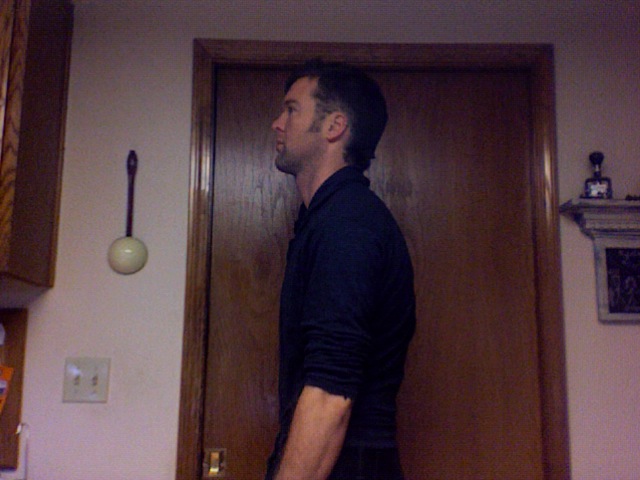
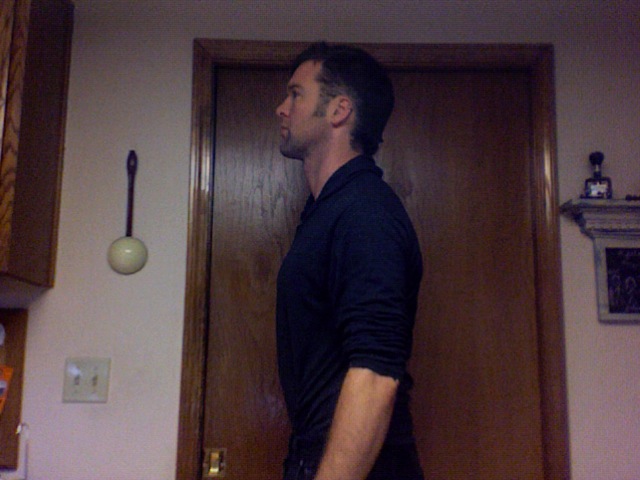
So … here’s me, shoulders slumped, endlessly thinking I should try harder and pull myself back into a good shape, like so.
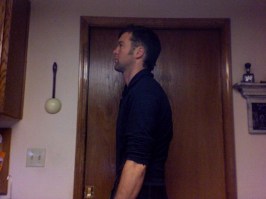
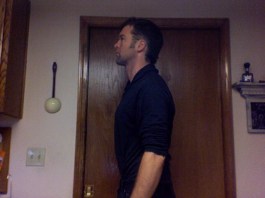
And as soon as I stop thinking about it, stop efforting so intensely, what happens? Slump.
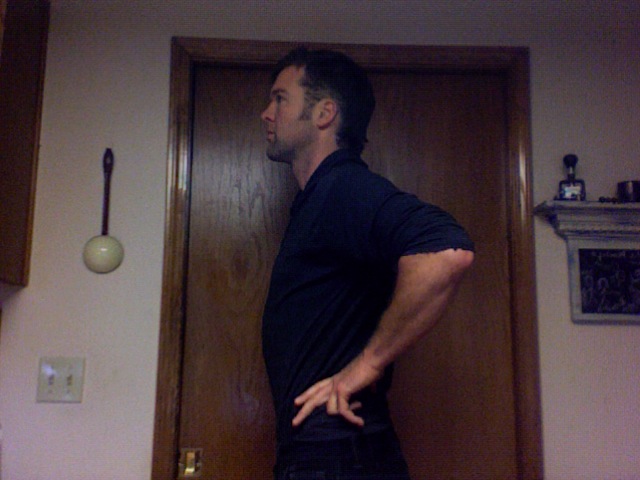
The new experiment is to look the next segment down: I’m going to tilt my pelvis forward (stick your butt out) and backward (tuck your tail) and search for a new position there, using how my shoulders sit as the primary metric for the quality of this new position. I’m tipping forward and back (already a sort of circuit-scrambling activity), literally using my felt sense as a guide to how my shoulders are sitting, and how easily my breath travels to my upper ribs.

You don’t need to put your hands on your pelvis like I am in this photo; this is just to show what I’m talking about (though you’re welcome to at first, but then relax your arms down so you can start feeling their position).
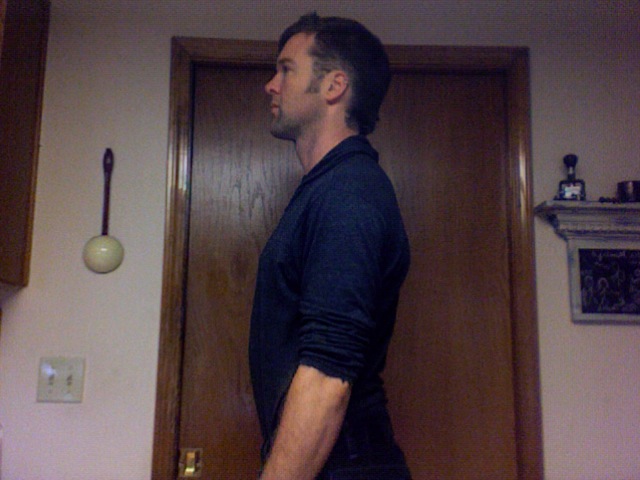
For me, I get this new shape. This positing of my shoulders feels a lot more natural for me (and is constantly evolving!). Again, though, to find this position I didn’t put any emphasis on my shoulders sitting any particular way. I played with tilting my pelvis forward and back and “listened” to my shoulders and breath.

Take another look at these two figures side-by-side. Which one would you guess is breathing more easily?
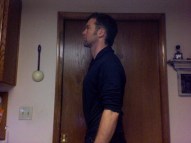
Pulling shoulders back, trying to stand up straighter.

Change in pelvic position, no emphasis on how shoulders sit.
Got it? Change a different part of your structure than you’re used to, but feel for the quality of ease you’re looking for in the place you usually look for it.
Another note for this particular exercise: should you end up with a pelvic position that’s tipped more forward or back? That answer will totally depend on each person, though a good clue and rule of thumb: the most neutral position for any joint is where you are (it is) at your (its) tallest point. Some of us are more inclined to live in the tail-tucked position, while others are more inclined towards the gut-falling-forward position (like me in real-life, though I played the opposite part here). Or, just maybe, you’re dead-center neutral already.
Try it. This one in particular is a great exercise to try sitting, too (I’d suggest fully unweighting your sitz bones when you tip your pelvis forward or back, and then of course re-weight them as you sit). Again, as you change your pelvic position, pay attention to how this affects your shoulders’ position over your ribcage. The quality, depth and ease of your breathing is a great functional way to feel the anatomical difference (it’ll be easiest to breath fully, without too much effort, at your best anatomical position).
Enjoy!
And if I sound like a bit of a broken record, it’s because I am. Or rather, I feel like these fundamental changes are so, so important for more easeful, pain-free living. For more posts like this, you can also check out Try Something Different, Leverage, Willpower and Trajectory, Relationship Troubles, or take the Anatomy Pop Quiz!
 dynamicalignmentbodywork.com